(Cardiovascular Assessment Screening Program)
The CASP tools will guide you in the systematic assessment of traditional and non-traditional CVD risk factors in a convenient efficient way. All the major risk factors are assessed together in the CASP App so individuals know what all their unique risks are at the same time. The CASP App will help you to calculate their overall level of CVD risk. There are tips for communicating with individuals in a motivating way. CASP has different strategies and resources for management so you can individualize care at your fingertips in your clinic or work setting.
To use CASP, navigate through each step by clicking below to review details.
Ask your patients to complete the CASP Self-assessment by downloading the fillable PDF and bringing it back to you to discuss.
This is a separate self-assessment for individuals at risk for heart disease or stroke or already diagnosed but who would like to manage their risk factors proactively.
You can use the CASP Self-Assessment as a starting point as part of your focused CV health history in the next step in the CASP process.
Review the CASP Self-Assessment that your patient completed as a starting point for your own assessment.
Use Visit 1 section of the CASP Screening Checklist to guide your focused history and physical assessment. Some of the CASP Screening Checklist items relate to the history and physical exam, while others relate to tests to order.
Using this checklist ensures that you will conduct a comprehensive CV assessment using a systematic approach.
For more information, use the following calculators:
Framingham Risk Score (FRS):
https://ccs.ca/frs/
Note that this if for those who have never been diagnosed with heart disease or stroke.
Heart Age:
https://www.heartfoundation.org.au/heart-age-calculator
Enter a four-digit number for the postal code (e.g., 3127) to get the results.
Note that communicating the Heart Age for younger individuals at higher risk may encourage positive health behaviour change.
Download Behaviour Change and Motivational Interviewing Guide
Document the test results, goals, management options etc. in your usual documentation system.
Documenting CASP-Related Actions and Plans
Ongoing Support for Individuals and Follow-up
This Resource Centre provides the clinical tools required for patient assessment in clinic and workplace settings, including scales, measuring tapes, and blood pressure cuffs. It also includes quick-reference materials and links to supplementary resources used in completing the CASP Screening Checklist, such as calculators for Body Mass Index (BMI), Heart Age, Framingham Risk Score, and Life Expectancy.
Resources may be accessed directly within this section or via the CASP Screening Checklist, where additional guidance is provided on the accurate measurement of physiological parameters and the development of appropriate clinical goals and action plans.
 Tape for measuring waist circumference
It is important to measure waist circumference accurately and to monitor progress over time with a patient’s improvement. Use the following guide: Healthy weight and waist | Heart and Stroke Foundation. Video available for accurate measurement: https://www.youtube.com/watch?v=G2bmwZtZMv4
 Accurate and reliable body weight scale for measuring height and weight
Remember that individuals need to be approached about maintaining a healthy body. Use the 5 A’s when counselling the public about their weight. Link to Obesity Canada Guidelines for more information: Adult clinical practice guideline | Obesity Canada
Be certain that the weigh scale that you are using can weigh up to 500lbs or higher, otherwise you may not be getting an accurate measurement for some individuals.
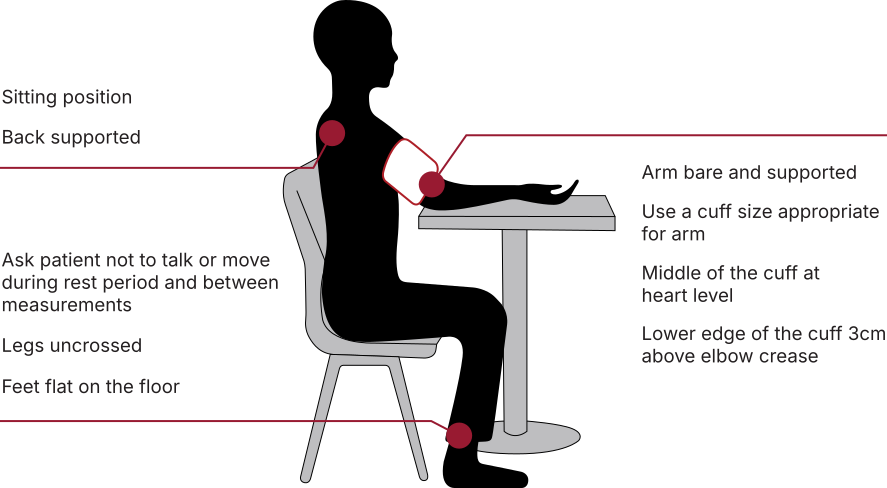
 Automated blood pressure monitor
Provider (and patient) information about taking an accurate Home BP measurement: Hypertension BP booklet.
List of recommended BP devices from Hypertension Canada: Recommended Devices – Healthcare Professionals – Hypertension Canada | For Healthcare Professionals